Where do wrens nest?
Wren · Troglodytes troglodytes
Wrens nest low down in sheltered nooks: thick ivy on a wall or tree, hedges, banks, upturned tree roots, crevices, sheds and open-fronted nest boxes. The nest is a ball of moss, leaves and grass with a small hole in the side. The male builds several, and the female picks one to line and lay in, from April onwards.
Nyth turns this into a puzzle. Play a level


- Where
- Low, sheltered nooks: ivy, hedges, banks, roots and sheds
- Nest
- A domed ball of moss and leaves with a side entrance
- When
- April to July, first eggs usually early May
- Eggs
- Usually 5 or 6, kept warm by the female for about 16 days
- Broods
- One or two
- Fledging
- About 2 to 2½ weeks after hatching
- Builder
- The male, several nests at once
Where wrens nest
Low down, somewhere dark and tangled. In woodland that means the thick undergrowth, a bank, the roots of a fallen tree. In a garden it means ivy and climbers on walls and fences, the bottom of a hedge, a log pile, or a gap in a shed, where wrens have been known to nest in anything from old coats to bits of junk.
For such a tiny bird the wren is everywhere. It is one of the commonest birds in Britain, and almost any garden with some thick cover is wren territory.
What a wren’s nest looks like
A ball. It is a domed nest of moss, leaves and grass, woven into its spot, with a small round entrance in the side. Because it is made of whatever is around it, a wren’s nest in ivy can look exactly like a clump of dead ivy leaves.
The best part: the male builds several of them. These are known as cock nests, and in southern Britain he might make five or six, sometimes more. The female goes round inspecting them, chooses one, usually the best hidden, and lines it with feathers. The rest are left empty, though wrens do sometimes roost in them.
When wrens nest
From April to July. The first eggs are usually laid in early May, and there are normally five or six of them, small and white with fine reddish speckles. The female sits on them for about 16 days, and the chicks leave about two weeks after hatching. Many pairs then raise a second brood, though in the far north often only one.
In the south, some males are busy enough to have two or more females nesting in their territory at once, in different cock nests.
How to help wrens nest in your garden
Wrens are on the Amber list. Their numbers drop hard after cold winters, so a good spring matters. The best thing is messy cover:
- Let ivy and climbers grow thick on a wall, fence or tree, and leave the bottom of a hedge untidy.
- Make a log pile or a brush pile in a corner. It is somewhere to nest and full of the tiny insects and spiders wrens eat.
- Try an open-fronted box, hidden low in ivy or a hedge, below 2 metres. The RSPB suggests a slightly taller front panel than on a robin box.
- Cut hedges in autumn and winter, outside March to August, and check for those well-hidden balls before you start.
Checked against: RSPB: Wren, BTO BirdFacts: Wren. Last checked 8 November 2026.
Your turn: find the robins a nest
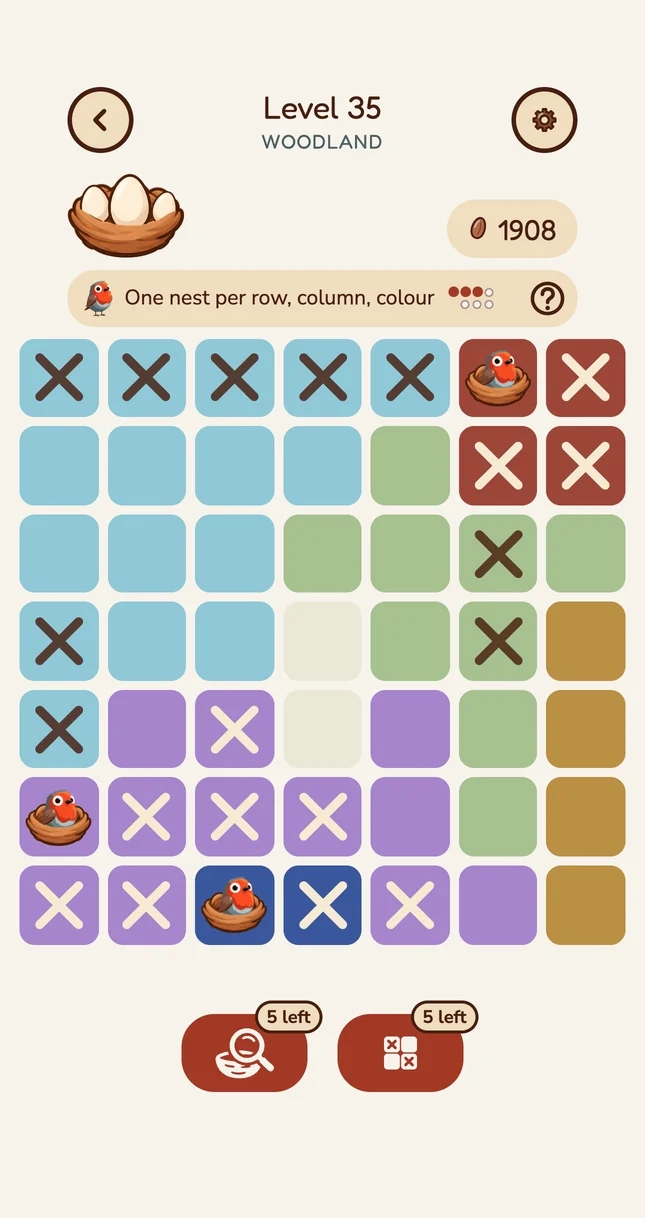
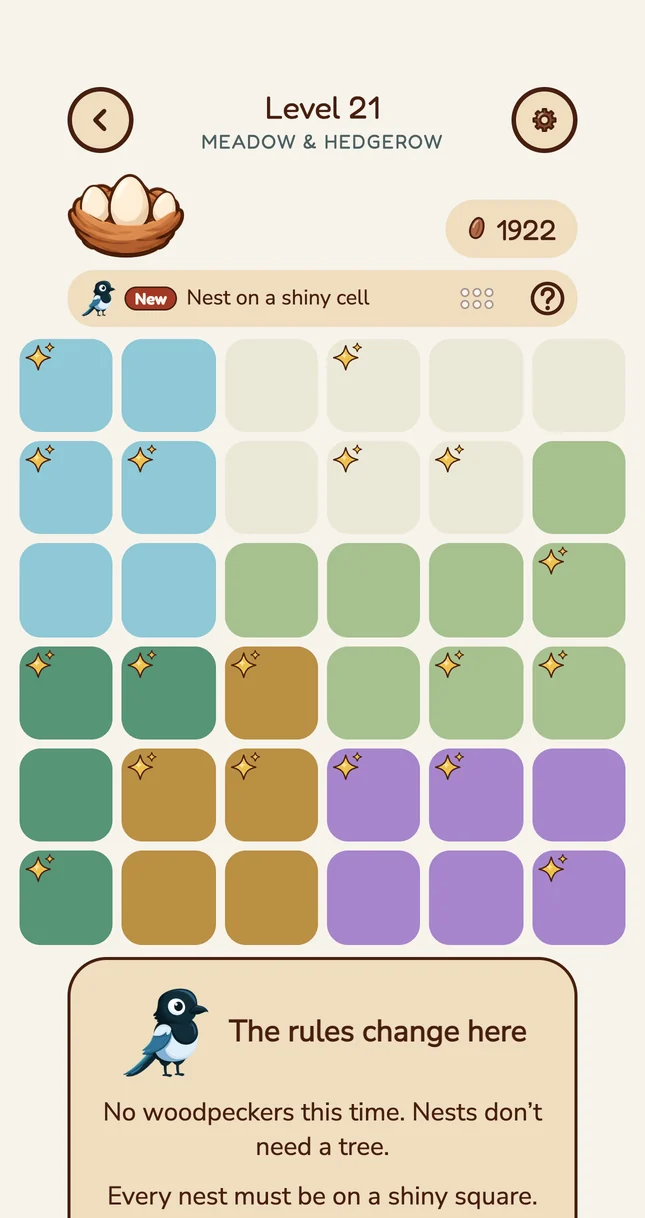
One nest in every row, every column and every colour, and no two nests touching, not even at a corner. Tap a square once to cross it off. Double tap to place a nest.

Every nest found
Those are the robin’s first three levels. The game has 1,000, and nineteen more birds.
On Android? Leave your email to hear when it is out there.
I only email about my games. Unsubscribe any time. Privacy policy
Questions
Why does a male wren build more than one nest?
So the female can choose. She inspects his cock nests, picks one, and lines it with feathers before she lays.
When do wrens nest?
From April to July, with most first eggs laid in early May. Many pairs raise two broods.
Do wrens use nest boxes?
Sometimes. An open-fronted box hidden low in thick ivy or a hedge is the most likely to be used.
Do wrens use their nests in winter?
They can roost in them, and on cold nights wrens huddle together for warmth. One Norfolk nest box was recorded with 61 wrens roosting in it in the winter of 1969.